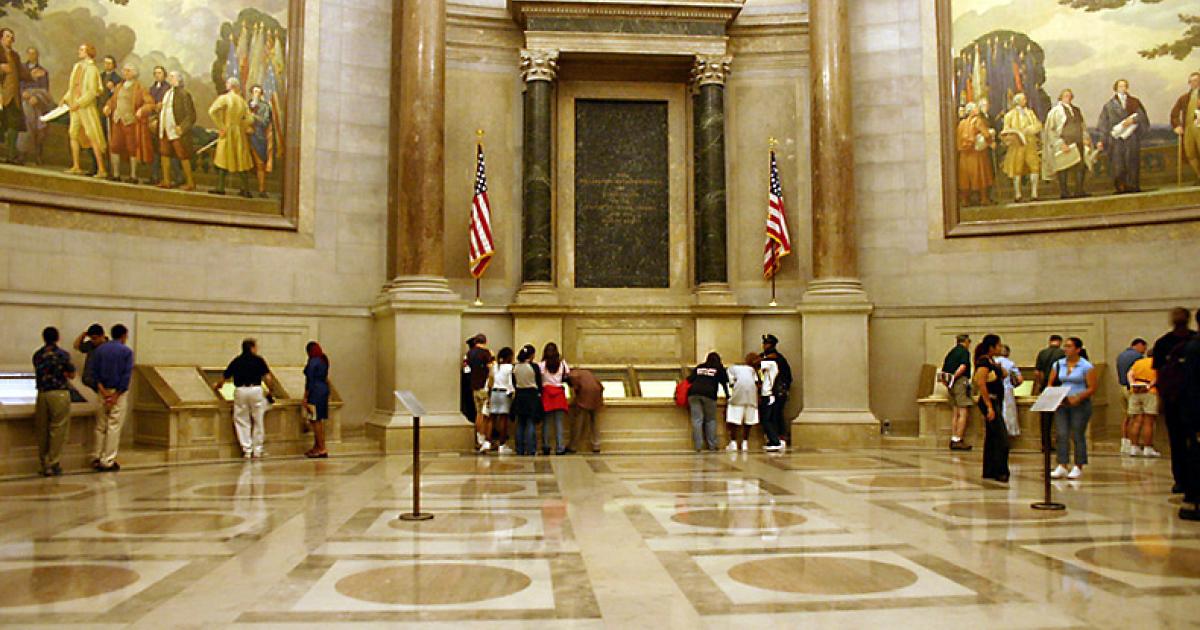
Noting its physical location in the Rotunda “properly central and above all,” Ford called the Declaration “the Polaris of our political order — the fixed star of freedom.” That document, adopted two days after the vote to separate from Great Britain, “is impervious to change because it states moral truths that are eternal,” Ford explained to the world. The dangerous a in the eighth line, made the sentence read “…whenever any Form of Government becomes destructive of these Ends [of securing life, liberty, and the pursuit of happiness], it is the Right of the People to alter or to abolish it, and to institute a new government…” To suggest that the people could institute “a new government” implied the possible creation of a unitary, centralized entity, which in July 1776 was anathema to the representatives of the thirteen colonies assembled “in Congress” in Philadelphia. Reframed by Abraham Lincoln as an “eternal emblem of humanity,” he made the Declaration’s equality claim central to Americans’ understanding of their “great chart of liberty.” Unity, it is true, was imposed by force during the Civil War, for the issue of slavery was an irreconcilable one, but the Declaration’s appeal has more often worked through persuasion and inspiration, as it did in the 1960s, when Martin Luther King, Jr., called upon the Nation to honor the “promissory note” of equality pledged in 1776 and 1863.
Author: February 10, 2026
Published at: 2026-02-10 00:00:00
Still want to read the full version? Full article